
When hiring becomes difficult, most companies start by looking for recruiting support.
It’s a practical response. Vacant positions slow productivity, place additional pressure on existing employees, and make it harder for the business to keep moving forward.
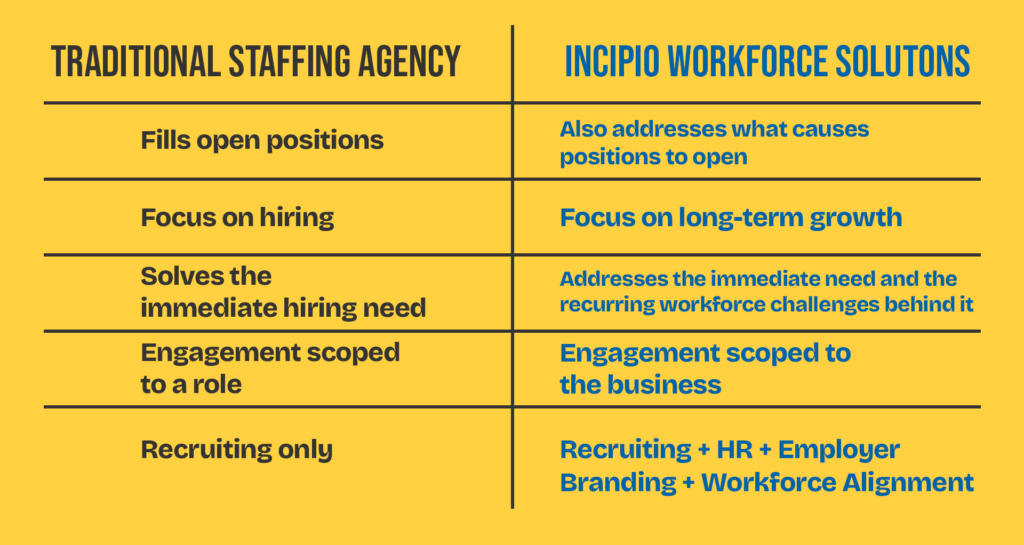
For many organizations, that means turning to a staffing agency to fill immediate openings. A workforce partner takes a broader view, examining why hiring challenges are occurring and how factors such as retention, leadership, culture, and employee experience contribute to them.
The difference becomes important when positions are filled, but the workforce challenge continues. Turnover costs continue to rise. Managers feel stretched thin. New hires aren’t staying as long as expected. Departments are growing faster than communication and leadership practices can keep pace.
Looking at the workforce as a system
Recruiting, retention, leadership, employer branding, HR practices, and culture don’t operate independently.
Difficulty attracting candidates may stem from how the organization is perceived in the market. High turnover may be connected to inconsistent leadership. Managers may be struggling because roles, expectations, or processes haven’t evolved with the business.
Viewing workforce challenges as part of a connected system helps organizations address the root cause rather than repeatedly treating symptoms.
A strong workforce strategy creates alignment between the people an organization wants to attract, the experience employees have once they join, and the business objectives those employees are expected to support. When those pieces reinforce one another, organizations are better positioned to improve hiring quality, strengthen retention, and support long-term growth.
A different kind of partnership
An organization struggling to hire production employees may initially believe it has a recruiting problem. Positions are filled, yet six months later, turnover remains high, and many of the same roles are open again.
That recurring pattern points to a broader workforce challenge.
A workforce partner examines the conditions surrounding it. How are new employees being onboarded? Are managers creating consistent expectations? Does the employer brand reflect the actual employee experience? Are communication and HR practices supporting retention?
The goal is to understand what is driving the workforce challenge and build a strategy around it.
This is where our work at Incipio begins.
We work alongside leadership teams to understand what is happening across the workforce and how those challenges are affecting business performance. Depending on the organization’s needs, that can include workforce alignment, applicant recruiting, employer branding, and HR services.
- Workforce Alignment helps identify the root causes of turnover and performance challenges by examining how people, roles, processes, and business priorities work together.
- Applicant Recruiting focuses on attracting people who are aligned with both the role and the organization, supporting stronger hiring outcomes from the beginning.
- Employer Branding helps organizations communicate a clearer and more accurate employee value proposition so that candidate expectations better reflect the experience they will have after joining.
- HR Services strengthen the processes and practices that support employees throughout their experience with the organization, including onboarding, communication, compliance, and retention.
Together, these areas give leaders a more complete view of the workforce and enable them to address the root causes of recurring challenges rather than each vacancy in isolation.
When the hiring problem keeps coming back
The distinction becomes especially important when the same workforce issues continue to resurface.
If turnover remains high after positions are filled, the next hire alone is unlikely to change the pattern. If leadership challenges are affecting engagement, increasing recruiting activity won’t resolve the leadership issue. If employees consistently leave because the experience doesn’t match their expectations, bringing more people into the same environment can accelerate the cycle.
These patterns are signals that the organization needs greater clarity around how its workforce supports the business.
Organizations rarely outgrow the need for great people. They do, however, outgrow workforce strategies that no longer match where the business is headed.
Recognizing that shift gives leaders the opportunity to make workforce decisions that strengthen long-term business impact.
Build a workforce that supports long-term growth
Recurring vacancies, rising turnover, and leadership challenges are often connected. Understanding how those issues influence one another is the first step toward creating a more stable workforce.
If your organization continues to hire but the same challenges keep returning, take the Workforce Stability Scorecard to identify opportunities across your organization.
You can also schedule a Workforce Strategy Conversation to discuss what’s happening within your organization and where a more aligned workforce strategy could support long-term growth.