
When we opened the doors of Incipio Workforce Solutions, Masonic Homes Kentucky was one of the first organizations we started working with. Ten years later, they still are. That’s not something I take lightly, and it doesn’t happen by accident in this industry.
Long-term care doesn’t run on good intentions alone. It runs on people showing up, shift after shift, ready to care for residents who depend on consistency as much as they depend on skilled hands. That reality has shaped how I think about workforce solutions. A decade is long enough to watch workforce trends come and go, to live through a pandemic that upended long-term care workforce nationwide, and to learn what actually works when the stakes are this high. Here’s some of what this partnership has taught me.
What long-term care workforce requires
Most industries can absorb a workforce gap for a week or two while they backfill a role. Long-term care communities need more precision than that. A missed shift on a nursing floor isn’t an inconvenience; it’s a resident who doesn’t get the help they need getting dressed, or a care team stretched too thin to give people the attention they deserve. Masonic Homes Kentucky, as one of the largest continuum-of-care providers in the state, manages that responsibility across independent living, assisted living, memory care, skilled nursing, and rehabilitation services.
That’s part of why this relationship has lasted as long as it has. Staffing a long-term care community isn’t a job you can do from a distance. It takes an understanding of the culture, the compliance requirements, and the specific rhythms of care work that only comes from being in it alongside the people doing the hiring.
What ten years of partnership have actually looked like
A decade of working together means my team isn’t starting from scratch every time a need comes up. We understand Masonic’s culture, their standards for who belongs on their care teams, and what “the right fit” means for an organization whose whole mission is caring for people at some of the most vulnerable points in their lives.
That history shows up in practical ways:
- Faster, more accurate workforce. We’re not learning the organization on the fly. We know the roles, the credentialing requirements, and what a good long-term care hire actually looks like.
- Workforce alignment, not just placement. Filling a shift is the easy part. Building a team that stays, grows, and holds up under the demands of care work is the more valuable work, and it’s the work I care most about.
- A partner who understands the mission. Long-term care isn’t a transactional industry, and I’ve never believed it should be staffed by a transactional process. Ten years in, I like to think we operate less like a vendor and more like an extension of their team.
Why this matters beyond one partnership
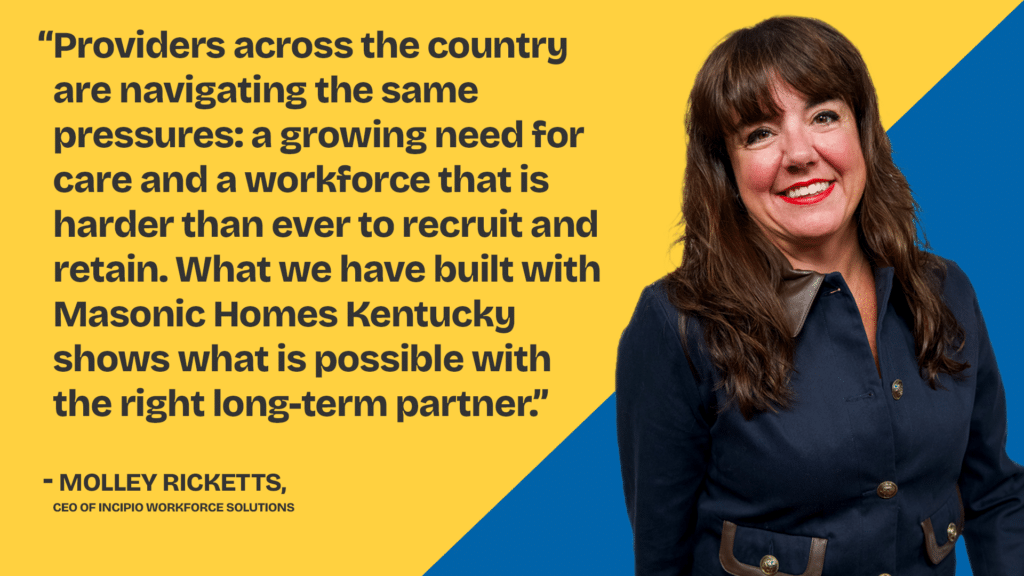
Long-term care workforce challenges aren’t unique to any one organization. Providers across Kentucky, and across the country, are navigating the same pressures: an aging population that needs more care, not less, and a workforce that’s harder than ever to recruit and retain. What we’ve built with Masonic Homes Kentucky is proof to me that those pressures can be met with the right long-term partner, not just a series of short-term fixes.
That’s the model I’ve built Incipio around, and the one I bring to every long-term care and senior living organization we work with: workforce, HR support, and employer branding built on the reality of the industry, not a generic playbook borrowed from elsewhere.
Ten years with Masonic Homes Kentucky isn’t just a milestone I’m proud of. It’s proof of what workforce solutions can look like when they’re built for the long haul.
Interested in what a long-term workforce partnership could look like for your organization? Get in touch with Incipio Workforce Solutions to start the conversation.